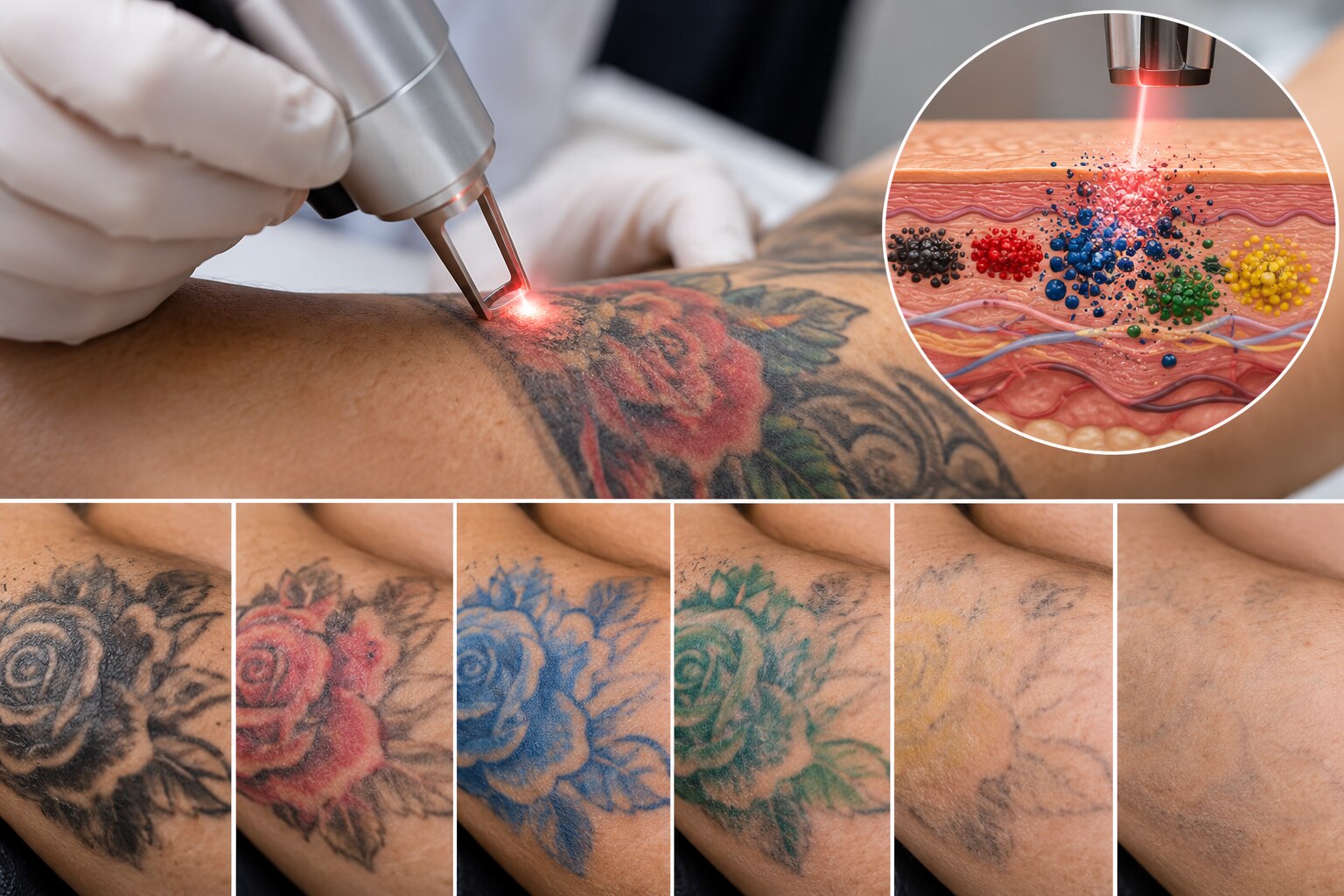
Tattoo ink does not respond uniformly: black, red, green, white and cosmetic pigments absorb different wavelengths, while ink depth changes how quickly fragments clear. By the end, you will understand why clinicians select particular wavelengths and settings, why multicolour tattoos need staged treatment, and how to assess a realistic plan for sessions and recovery.
Key takeaways
- Laser pulses fragment ink particles beneath the skin for gradual immune-system clearance.
- Black ink usually responds differently from green, blue, red or yellow pigments.
- Cosmetic tattoos need patch testing because some pigments can darken after laser exposure.
- Session numbers depend on ink colour, depth, density, location, skin type and healing.
How laser pulses break down tattoo ink at different depths
Laser light can pass through the epidermis and reach pigment in the dermis because the selected wavelength travels into skin rather than stripping its surface. Ink absorbs that wavelength more strongly than the surrounding tissue, allowing selective photothermolysis to concentrate energy around pigment particles while limiting injury to nearby skin.
The laser tattoo removal mechanism depends on pulse duration as well as energy. A Q-switched nanosecond or picosecond pulse arrives faster than heat can spread from the ink into surrounding tissue. That sudden absorption creates pressure and causes photoacoustic fragmentation: large pigment particles break into smaller fragments instead of the skin being burned away.
Macrophages and lymphatic drainage then remove some fragments, so fading continues for weeks.
A dermis depth comparison explains why surface fading does not mean complete removal. Pigment in the upper dermis receives more effective light and often clears sooner; ink deposited deeper receives less delivered energy and can leave a faint shadow after several sessions.
Clinicians adjust fluence, spot size and treatment intervals rather than simply increasing power, because excessive energy raises the risk of burns, scarring, prolonged redness and unwanted lightening or darkening of the skin.
Temporary white frosting immediately after a pulse comes from rapidly formed gas bubbles. It usually fades within minutes and does not show that all ink has disappeared.
Which laser wavelength works for each tattoo colour?
Each pigment absorbs particular wavelengths of light, so the clinician matches the wavelength to the ink rather than treating every colour with the same setting. The correct match concentrates energy in the pigment, fragments it, and limits unnecessary heating of surrounding skin.
| Pigment colour | Commonly selected wavelength | Why it is used |
|---|---|---|
| Black | 1064 nm | Black ink absorbs this wavelength broadly, including deeper deposits. |
| Red | 532 nm | Red pigment usually absorbs frequency-doubled Nd:YAG light efficiently. |
| Orange | 532 nm | Orange often responds to 532 nm, although formulation affects fading. |
| Yellow | 532 nm | Some yellow pigments absorb 532 nm, but pale yellow can remain resistant. |
| Green | 755 nm alexandrite laser, 694 nm ruby laser, or 730 nm laser devices | These wavelengths can target green pigments that respond poorly to 1064 nm or 532 nm. |
| Blue | 755 nm alexandrite laser, 694 nm ruby laser, or selected 730 nm laser devices | Blue tones vary by formulation, depth and shade, so one wavelength does not suit every tattoo. |
Dark blue can also respond to 1064 nm, especially when the pigment lies deeper in the dermis. Green and blue have historically taken longer because they absorb common 1064 nm and 532 nm wavelengths less efficiently.
A multicolour tattoo therefore needs colour-specific passes; using one wavelength across the whole design can leave resistant areas or expose responsive pigments to excess energy.
Why multicolour and cosmetic tattoos need extra caution
One laser setting can fail on a multicolour tattoo because each pigment absorbs a different wavelength and breaks apart at a different rate. A wavelength that clears black ink can leave green, yellow or turquoise areas behind, while applying it across the entire design exposes responsive colours to unnecessary energy.
Multicolour tattoo removal therefore requires colour-by-colour planning, not one pass over the whole image.
Before treatment, check:
- Identify every colour, including white, beige and flesh tones hidden beneath darker ink.
- Ask whether the design contains layered cover-up ink; deeper or overlapping pigment can respond unevenly.
- Request a small test spot when cosmetic or pale pigment is present.
- Confirm that the clinician will reassess the skin before treating the full area.
Microblading and permanent-makeup pigments are not simply small tattoos. They can contain iron oxides, titanium dioxide and other compounds that react differently from standard tattoo inks. An iron oxide pigment laser reaction can turn brown, grey or black after exposure, producing darkening instead of fading.
White and flesh-coloured pigments can show the same problem, so a test area matters.
A Q-switched laser or picosecond laser may be selected according to pigment chemistry, depth and colour—not the device label alone. Tell the clinician about every cosmetic tattoo before treatment, including old brow, lip or eyeliner pigment.
What happens during a treatment and how settings are chosen
A session involves skin assessment, photographs, protective eyewear, cleansing and laser passes over the tattoo. You may feel hot pinpricks or snapping, followed by whitening of the treated area, swelling or pinpoint bleeding. Cooling reduces discomfort and limits heat in surrounding skin.
- The clinician checks pigment colour, depth, density, previous treatment, skin tone and any scar tissue.
- A small test spot helps assess the skin’s response before treating the full tattoo.
- After treatment, the area is cooled and covered with appropriate wound-care instructions.
| Setting | How it is chosen | Why it matters |
|---|---|---|
| Wavelength | Matched to the ink colour and depth; multicolour tattoos may need separate wavelengths | The wrong wavelength can leave resistant pigment or deliver unnecessary energy |
| Fluence J/cm² | Increased cautiously until the pigment shows an effective endpoint without excessive tissue injury | Too little energy achieves little; too much raises blistering, scarring and pigment-change risk |
| Spot size | Adjusted for tattoo size, depth and skin response; larger spots reach deeper with less surface intensity | Smaller spots provide precision but take longer and concentrate energy |
| Pulse duration and repetition rate | A picosecond or Q-switched nanosecond pulse is selected, while repetition rate controls how quickly pulses are delivered | Short pulses favour pigment fragmentation; excessive speed can build heat before the skin cools |
How many sessions are needed, and what affects safety and fading?
Many tattoos need several sessions, and size alone cannot predict the total. Deep, dense or layered pigment takes longer to fragment and clear than a lightly applied tattoo in the superficial dermis.
The main factors that change session count and risk are:
- Depth and pigment density: deeper ink may require lower, carefully staged treatment and more visits.
- Location: areas with slower circulation or less effective immune clearance can fade more slowly.
- Healing time: 6–8 week treatment intervals allow the epidermis to recover and the body to remove pigment fragments. Shortening the gap does not reliably speed fading.
- Skin response: smoking, previous scarring, infection, immune clearance and individual pigment reactions can alter the result.
- Pigment composition: white and cosmetic pigments need extra caution because they can darken or resist removal.
Temporary redness swelling blistering crusting and pinpoint bleeding can follow treatment. Lighter or darker patches, called hypopigmentation and hyperpigmentation, can persist after inflammation settles. Excessive fluence, treating before the skin heals, infection or a tendency to form scars raises the risk of lasting texture changes.
Follow tattoo removal aftercare closely: keep the area clean, avoid picking crusts, protect it from sunlight and report spreading redness, pus or worsening pain. Dr Megha Kadam-Best Skin Specialist 08048033401 can assess depth, pigment and skin response before deciding whether the next session is safe.
Frequently asked questions
How does laser tattoo removal reach ink at different depths?
A selected wavelength passes through the epidermis and targets ink particles in the dermis. Short pulses fragment pigment while limiting heat exposure to surrounding skin.
Which laser wavelength works for each tattoo colour?
The suitable wavelength depends on the pigment’s absorption. Q-switched or picosecond lasers commonly use 1064 nm for black and some dark pigments, 755 nm for many blue and green pigments, and 532 nm for red, orange and some yellow pigments.
Why do multicolour and cosmetic tattoos need extra caution?
Different pigments require different wavelengths, while cosmetic pigments containing iron oxide or titanium dioxide can darken after laser treatment. Patch testing and careful assessment help reduce risk.
How are laser settings chosen during treatment?
A clinician assesses tattoo colour, depth, density, location, skin type and previous reactions before selecting wavelength, fluence, pulse duration and spot size. Settings are adjusted as the skin heals.
How many laser tattoo removal sessions are needed?
The number varies with ink colour, depth, density, location, skin type, immune response and healing between sessions. Deeper or multicolour tattoos usually require more staged treatments.